Collagen shop guide
Liquid collagen drinks for skin, hair, nails, joints
This shop has two ten-bottle collagen drinks and two collagen droppers. The drink boxes are marked 10,000 mg. The dropper panels are marked 50 mg and 40,000 mcg.
Key takeaways
- The Revive box front says 10 bottles of 10,000 mg marine collagen, vitamin C and E, and CoQ10, for skin, hair, and nail repair. Heivy Revive collagen drink 10-pack pack shot
- The Revive panel lists 9 g protein for one 50 ml bottle. Fish collagen sits in a 10,201 mg blend with CoQ10, jasmine extract, and piperine. For one 50 ml bottle, the Elite panel lists 10 g fish collagen, vitamin C 54 mg, vitamin E 0.3 mg, biotin 75 mcg, 5 g sugars, protein 9 g, and coenzyme Q10 15 mg. The 10 g fish collagen line is not the protein total. Heivy Revive collagen drink Supplement Facts panel Heivy Revive Elite collagen drink Supplement Facts panel
- The liposomal drops panel prints 50 mg hydrolyzed collagen and 20,000 mcg biotin per 1.5 mL, across 30 servings. Heivy liposomal liquid collagen drops pack shot
- The 4-in-1 panel lists 40,000 mcg hydrolyzed collagen per 1 ml, plus biotin 20,000 mcg, hydrolyzed keratin 5,000 mcg, and saw palmetto extract 5,000 mcg, across 60 servings. Heivy 4-in-1 collagen drops Supplement Facts panel
- A 2021 meta-analysis of 19 trials and 1,125 people favored hydrolyzed collagen for skin hydration, elasticity, and wrinkles. Meta-analysis of hydrolyzed collagen for skin hydration
- A 2025 meta-analysis of 23 trials and 1,474 people found a skin benefit in the company-funded trials, and no effect in the trials without pharmaceutical-company funding. 2025 meta-analysis of collagen supplements and skin aging
Buy the 10,000 mg drink, or a dropper measured in milligrams
Bottom line
Buy Revive for the box marked 10,000 mg marine collagen. Heivy Revive collagen drink 10-pack pack shot
For one 50 ml bottle, the Elite panel lists 10 g fish collagen, vitamin C 54 mg, vitamin E 0.3 mg, biotin 75 mcg, 5 g sugars, protein 9 g, and coenzyme Q10 15 mg. The 10 g fish collagen line is not the protein total. Heivy Revive Elite collagen drink Supplement Facts panel
Buy the liposomal drops for the panel that prints 50 mg hydrolyzed collagen per 1.5 mL. Heivy liposomal liquid collagen drops pack shot
The product page text names saw palmetto and 20 drops (1 mL). The photographed panel is 1.5 mL and lists banana stamen, not saw palmetto. Heivy biotin and collagen drops product page Heivy liposomal liquid collagen drops pack shot
Buy the 4-in-1 for 40,000 mcg hydrolyzed collagen per 1 ml, with biotin, keratin, and saw palmetto on that panel. Heivy 4-in-1 collagen drops Supplement Facts panel
Shop liquid collagen for skin, hair, and nails
NutriScore may earn a commission if you buy through these links. Every button opens Heivy's liquid supplements collection. Amounts and uses are what is printed on the bottles, checked September 30, 2026.
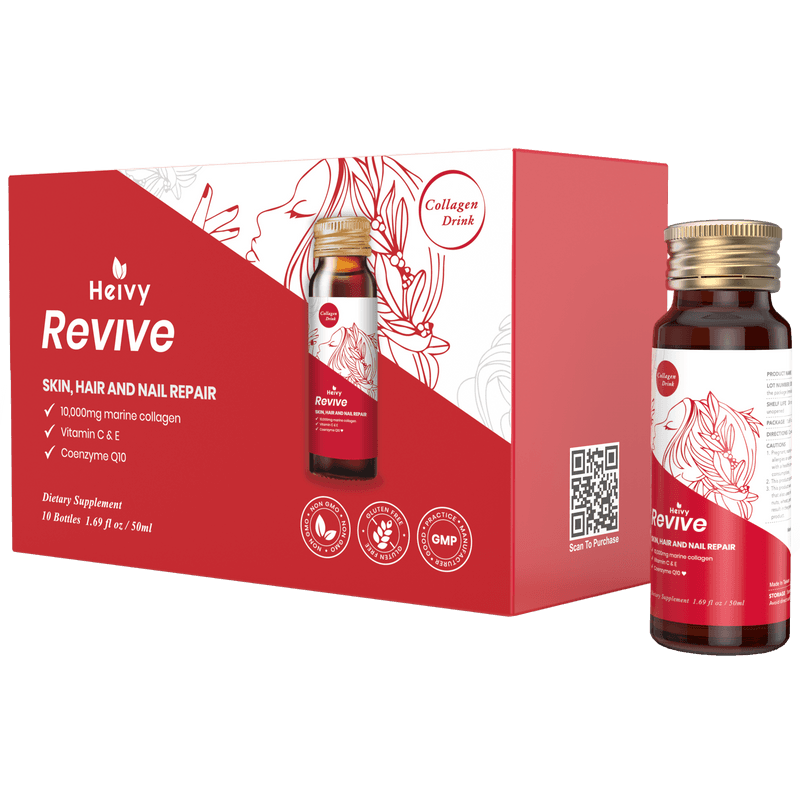
Revive collagen drink
Ten bottles. The box says 10,000 mg marine collagen, vitamin C and E, and CoQ10. The panel lists vitamin C 90 mg and biotin 150 mcg. Fish collagen is inside a 10,201 mg blend.
Shop Revive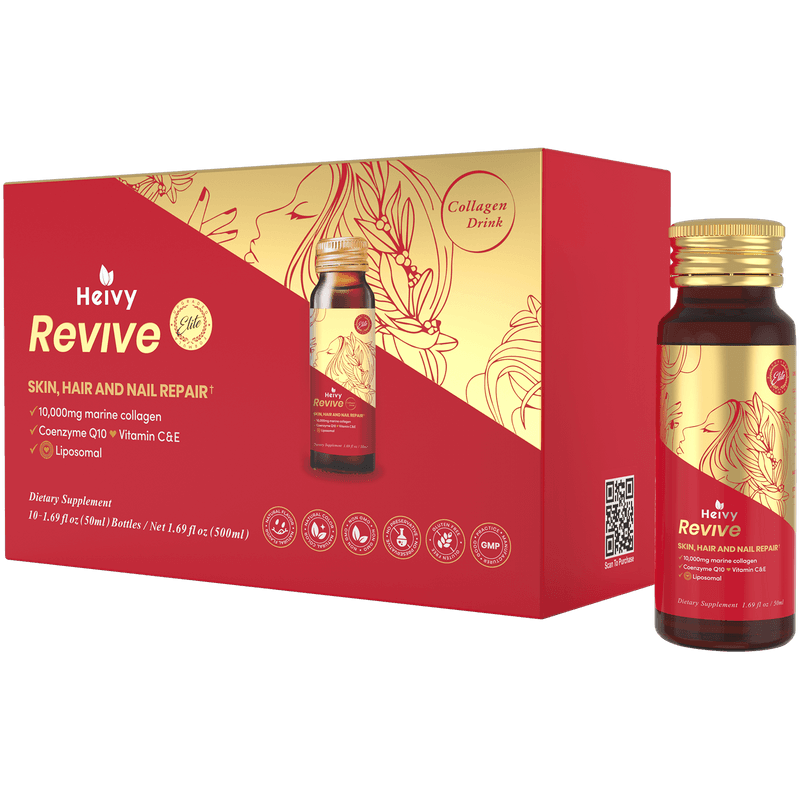
Revive Elite collagen drink
Ten bottles. Each one is labeled 10,000 mg marine collagen, with CoQ10, vitamins C and E, and a liposomal mark. The box says skin, hair, and nail repair.
Shop Revive Elite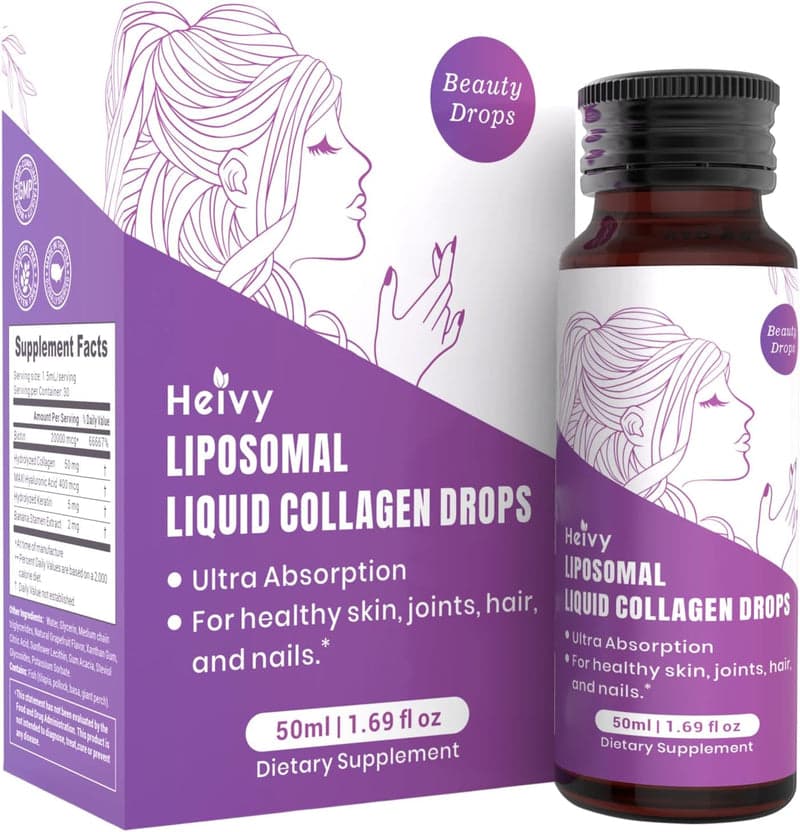
Liposomal collagen drops
The panel prints 20,000 mcg biotin and 50 mg hydrolyzed collagen per 1.5 mL serving, plus MAXI hyaluronic acid 400 mcg, hydrolyzed keratin 5 mg, and banana stamen extract 2 mg, for healthy skin, joints, hair, and nails.
Shop the collagen drops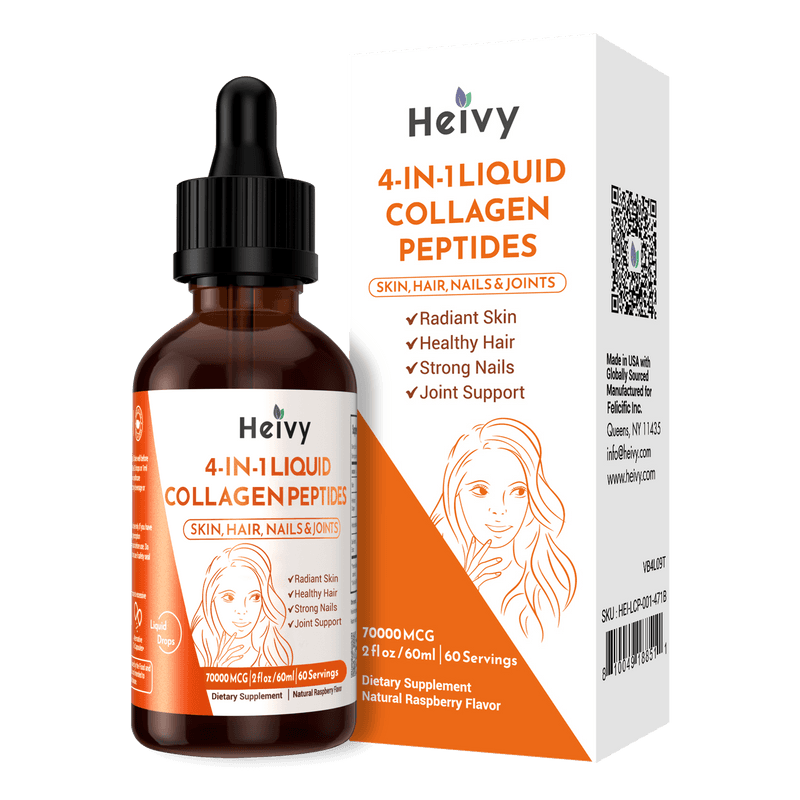
4-in-1 collagen drops
Natural raspberry flavor, 60 servings of 1 ml. The front is marked 70,000 mcg. The panel lists biotin 20,000 mcg, hydrolyzed collagen 40,000 mcg, hydrolyzed keratin 5,000 mcg, and saw palmetto extract 5,000 mcg.
Shop the 4-in-1 drops
The Revive panel lists 9 g of protein, and collagen inside the blend
One serving is the whole bottle: 1.69 fl oz (50 ml), one serving per container. The amount column lists 90 calories, 10 g sugars, and 9 g protein. Heivy Revive collagen drink Supplement Facts panel
Vitamin C is 90 mg, 100 percent DV. Biotin is 150 mcg, 500 percent DV. The 10,201 mg blend is collagen (fish), CoQ10, jasmine extract, and piperine, which the panel lists as Bioperine. Heivy Revive collagen drink Supplement Facts panel
Vitamin E is printed on the box. The amount column does not give it a milligram line. DL-alpha-tocopheryl acetate appears in the other ingredients. Heivy Revive collagen drink 10-pack pack shot Heivy Revive collagen drink Supplement Facts panel
Revive Elite is the second ten-bottle box. The front prints 10 bottles of 1.69 fl oz (50 ml), and the net line prints 1.69 fl oz (500 ml). It also says 10,000 mg marine collagen, CoQ10, vitamins C and E, a liposomal mark, and skin, hair, and nail repair. Heivy Revive Elite collagen drink pack shot
For one 50 ml bottle, the Elite panel lists 10 g fish collagen, vitamin C 54 mg, vitamin E 0.3 mg, biotin 75 mcg, 5 g sugars, protein 9 g, and coenzyme Q10 15 mg. The 10 g fish collagen line is not the protein total. Heivy Revive Elite collagen drink Supplement Facts panel
The dropper panels are 50 mg and 40,000 mcg of collagen
The liposomal bottle is 50 ml (1.69 fl oz), 30 servings. Beside the 50 mg hydrolyzed collagen per 1.5 mL, the panel lists biotin 20,000 mcg, MAXI hyaluronic acid 400 mcg, hydrolyzed keratin 5 mg, and banana stamen extract 2 mg. The box says it contains fish, and the use line is healthy skin, joints, hair, and nails. Heivy liposomal liquid collagen drops pack shot
50 mg is 50,000 mcg. Added to the 20,000 mcg biotin line on this panel, that is 70,000 mcg. The page title reads Heivy Biotin & Collagen Liquid Drops 70,000 mcg. Heivy liposomal liquid collagen drops pack shot Heivy biotin and collagen drops product page
The product page text names saw palmetto and 20 drops (1 mL). The photographed panel is 1.5 mL and lists banana stamen, not saw palmetto. Heivy biotin and collagen drops product page Heivy liposomal liquid collagen drops pack shot
A gallery image on that page says 1-2 drops a day. Heivy liposomal drops gallery image, 1-2 drops a day
The 4-in-1 front is marked 70,000 mcg, 2 fl oz (60 ml), 60 servings, natural raspberry flavor, for skin, hair, nails, and joints. The four panel amounts are 20,000 mcg biotin, 40,000 mcg hydrolyzed collagen, 5,000 mcg hydrolyzed keratin, and 5,000 mcg saw palmetto extract. They add up to the 70,000 mcg on the front. 40,000 mcg is 40 mg. Heivy 4-in-1 collagen drops pack shot Heivy 4-in-1 collagen drops Supplement Facts panel
Skin trials used gram doses, and the 2025 review splits by funding
De Miranda and colleagues pooled 19 randomized trials and 1,125 people, 95 percent of them women, ages 20 to 70. The grouped result favored hydrolyzed collagen over placebo for hydration, elasticity, and wrinkles. The authors tied that result to 90 days of use. Meta-analysis of hydrolyzed collagen for skin hydration
Myung and Park pooled 23 randomized trials and 1,474 people, with the search running through June 14, 2024. Across all 23, collagen supplements improved hydration, elasticity, and wrinkles. In the trials without pharmaceutical-company funding, those three measures showed no effect. In the trials the authors rated high quality, there was no significant effect on hydration, elasticity, or wrinkles. The low-quality trials showed a significant improvement in elasticity. 2025 meta-analysis of collagen supplements and skin aging
The authors concluded there is no clinical evidence that collagen supplements prevent or treat skin aging. 2025 meta-analysis of collagen supplements and skin aging
A 2022 review of 12 papers describes the doses in a few of the older trials. Its table lists Bolke and colleagues randomizing 72 healthy women 35 and older to 2.5 grams of collagen plus other active ingredients or placebo. The Bolke abstract assigns 36 women to that drink and 36 to placebo. Al-Atif 2022 review of collagen supplements for skin Bolke et al. 2019 trial of a 2.5 g collagen drink
The same table lists Sangsuwan and colleagues randomizing 36 postmenopausal women, ages 50 to 60, to an oral 5 gram collagen hydrolysate or placebo. The review text says Kim and colleagues randomized 64 Korean women to 1,000 mg of collagen or placebo every day for 3 months. The table gives their ages as 40 to 60. Al-Atif 2022 review of collagen supplements for skin
Bolke, Sangsuwan, and Kim did not test these Heivy bottles. Bolke et al. 2019 trial of a 2.5 g collagen drink Al-Atif 2022 review of collagen supplements for skin
The drink is the gram-scale box. The droppers are the milligram panels above. Heivy Revive collagen drink 10-pack pack shot Heivy liposomal liquid collagen drops pack shot Heivy 4-in-1 collagen drops Supplement Facts panel
Match the bottle in the photo before you buy
Read the box and the panel as two labels
Protein and the blend are on the Revive Supplement Facts panel. The 10,000 mg line is on the box front. Heivy Revive collagen drink 10-pack pack shot Heivy Revive collagen drink Supplement Facts panel
Elite is the ten-bottle liposomal box
The Elite front carries the liposomal mark and the 10,000 mg marine collagen line. Heivy Revive Elite collagen drink pack shot
The page names saw palmetto and the photo does not
The product page text names saw palmetto and 20 drops (1 mL). The photographed panel is 1.5 mL and lists banana stamen, not saw palmetto. Heivy biotin and collagen drops product page Heivy liposomal liquid collagen drops pack shot
Keep the 4-in-1 separate
The 4-in-1 is a different dropper. Read its collagen line in micrograms per milliliter. Heivy 4-in-1 collagen drops Supplement Facts panel Heivy liposomal liquid collagen drops pack shot
Sources
- Heivy Revive collagen drink 10-pack pack shot: https://cdn.shopify.com/s/files/1/0020/5753/5541/files/HEI-CD-001-001_2.png?v=1709127756
- Heivy Revive collagen drink Supplement Facts panel: https://heivy.com/cdn/shop/files/HeivyReviveSF_1.jpg?v=1709127756
- Heivy Revive Elite collagen drink pack shot: https://cdn.shopify.com/s/files/1/0020/5753/5541/files/Revive-HEI-CD-001-862-1.png?v=1775162927
- Heivy Revive Elite collagen drink Supplement Facts panel: https://cdn.shopify.com/s/files/1/0020/5753/5541/files/81VaNWLBCfL._AC_SL1500.jpg?v=1775162927
- Heivy liposomal liquid collagen drops pack shot: https://cdn.shopify.com/s/files/1/0020/5753/5541/files/71FnsJov2WL._AC_SL1500.jpg?v=1776797497
- Heivy biotin and collagen drops product page: https://heivy.com/products/heivy-biotin-collagen-liquid-drops-70-000-mcg-hair-skin-nail-support-heivy
- Heivy liposomal drops gallery image, 1-2 drops a day: https://cdn.shopify.com/s/files/1/0020/5753/5541/files/71qft6M_WDL._AC_SL1500.jpg?v=1776797497
- Heivy 4-in-1 collagen drops pack shot: https://cdn.shopify.com/s/files/1/0020/5753/5541/files/NO1_0087_bd32a45c-28a2-48f0-8080-6e352a11aba3.png?v=1733843478
- Heivy 4-in-1 collagen drops Supplement Facts panel: https://cdn.shopify.com/s/files/1/0020/5753/5541/files/HEI-LCP-001-471_4.png?v=1745244556
- Meta-analysis of hydrolyzed collagen for skin hydration: https://pubmed.ncbi.nlm.nih.gov/33742704/
- 2025 meta-analysis of collagen supplements and skin aging: https://pubmed.ncbi.nlm.nih.gov/40324552/
- Bolke et al. 2019 trial of a 2.5 g collagen drink: https://pubmed.ncbi.nlm.nih.gov/31627309/
- Al-Atif 2022 review of collagen supplements for skin: https://pmc.ncbi.nlm.nih.gov/articles/PMC8824545/
Keep reading
Buyer hub
Best greens powders
Score-driven list pages built from the current ranking snapshot.
Rankings
Full score table
Compare overall, safety, efficacy, and transparency scores.
Tools
Label calculators
Run price, protein, transparency, and COA math locally.
Topic hub
Label reading guides
Follow the claim, dose, badge, allergen, and COA article cluster.
Topic hub
Safety and testing guides
Read the heavy-metal, COA, certification, and warning-label cluster.
Methodology
How scoring works
Read the organization-level scoring and corrections posture.
How this article was made
NutriScore has not commissioned independent clinical review of this article.
Read the editorial policy and scoring methodology. Sources favor primary canon, regulators, product labels, and peer-reviewed research; reputable secondary reporting is identified when used.
Corrections: send corrections or updated label/source evidence to support@nutriscore.fit or use the contact page.
Sources: 13 entries, primary canon plus reputable secondary sources with inline acknowledgment, last reviewed 2026-10-06.
For research and educational purposes only. Not medical advice.